
Rudolph Puchner, 1829-1913
Rudolph Puchner was born 24 January 1829 in Beutelsbach, Wuerttemberg; he died 1913 in New Holstein, Wis. He immigrated in 1849 to America after taking part in the student uprisings of 1848. According to Robert E. Ward (A Bio-Bibliography of German-American Writers, 1670-1970), Puchner lived for several years among the Chippewa Indians, then established a business in New Holstein. He was a friend of Caspar Butz, Hermann Raster, and other German American 48ers and writers, and he contributed poetry and essays to several periodicals.
Obituary for Rudolph Puchner, The Chilton Times, 25 January 1913
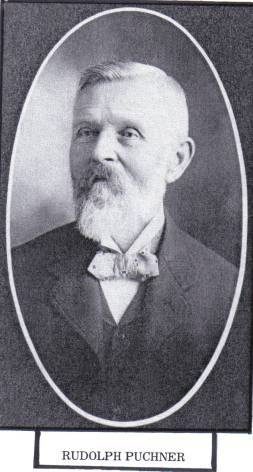
It is lamentable true that Death, the destroyer, is rapidly removing from their sphere of usefulness the sturdy pioneers who carved Calumet County out of the wilderness and made it one of the garden spots of Wisconsin. . . . This week on Sunday, Jan. 19th, Rudolph Puchner, one of the most prominent figures in the history of Calumet County and especially of the town of New Holstein, died at the home of his son in Wittenberg at the venerable age of 84 years.
Rudolph Puchner was born in Württemberg, Germany, Jan. 24, 1829, of rich, influential parents, his grandfather being a minister of the duke. He left his native home during the revolution of 1848 and came to America, landing in New York and proceeding thence to Sheboygan, this state, where after a short stay, he went to New Holstein to join the colony of his countrymen who had settled there the year before. In 1849 he put up a shanty in which he and a young man named Bruckner opened up the first store in New Holstein and conducted the same until 1851, when Mr. Puchner left for Chicago. In 1854 he returned and in partnership with his brother-in-law, Chas. Heins, established a store on a larger scale. In 1857 this partnership was dissolved and Mr. Puchner built a combined store and tavern, the latter being the resort of all the earlier settlers. He carried a large stock and did an enormous business for so small a town. . . . [yet] found ample time to read Shakespeare and Schiller, reflect on the beauties of their imagery and develop a remarkable poetic
Although a poet and scholar, Mr. Puchner did his full share of physical labor and underwent hardships that young men of today would call impossible. He was the first postmaster of New Holstein, which meant that he kept the office open, received, and distributed the mail. He carried the mail himself to Hayton, sometimes wading through the water breast deep and holding the mail bag high above his head to keep it dry, [as] most of the streams had no bridges and it was necessary to ford them. At one time in fording the Sheboygan River with a load, during high water, the greater part of his goods were lost and he was unable to recover them.
An experience in his business life which he liked to tell his friends of later days was of an insult which he unconsciously gave to an Indian, one of the wild Menomonees, who came into his store one evening, put his gun in the corner and asked to stay overnight. Mr. Puchner’s refusal to allow him to remain was taken as a deep insult by the Menomonee brave and he silently departed. On the morrow he returned, however, accompanied by three others, all besmeared with paint and armed with guns, tomahawks, and knives. Mr. Puchner knew that their appearance boded mischief and so prepared to sell his life as dearly as possible. He loaded his pistol and sat calmly behind the counter, his only hope being that some customer might come to his assistance, but not until the dusk of evening did the welcome sound of [a team loaded with flour from Calumet] fall upon his ear. The Indians then saw that they had more than one to deal with, so they stood up, one by one, silently filed out of the store and were seen no more for years.
Mr. Puchner lived to see all these conditions change and exerted his share of influence toward the general advancement of the community. He was in touch with all the prominent men of early days, with whom his suggestions and advice had great weight in settling public affairs. He was shrewd in business and successful in all his undertakings, which, considering the obstacles surmounted, means more than were it said of the business man of today.
He is survived by four sons, Dr. Edward and Rudolph of Wittenberg, Wm. of Chicago, and Alfred of Edgar. Funeral services were held at Wittenberg Wednesday afternoon, the body being taken to Milwaukee for cremation on Thursday.
Known Works
Aglaja (1887)
Erinnerungen aus den ersten Jahren der Ansiedlung New Holstein (1895)
Klänge aus dem Westen (1879, 1898)
Anna Ruland. Sittenbild aus dem Westen der Vereinigten Staaten (Dresden: E. Piersen, 1903)
“Recollections of the Forties,” by Rudolph Puchner [Translated from an article in the New Yorker Staats Zeitung, December 16, 1900] in North America, Wisconsin, Hints for Emigrants (1943), pages 69-72.