
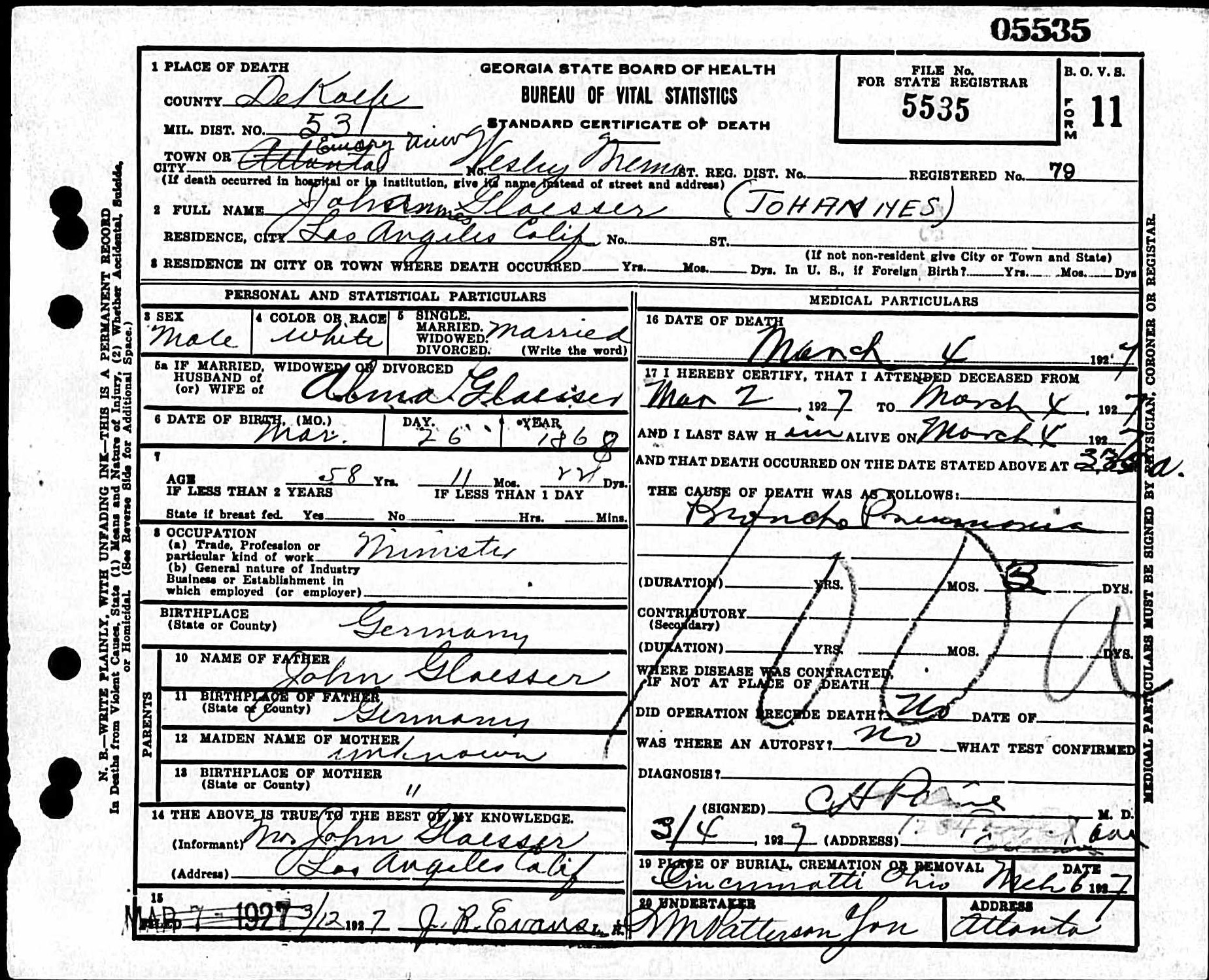
Johannes Glaesser, 1868-1927
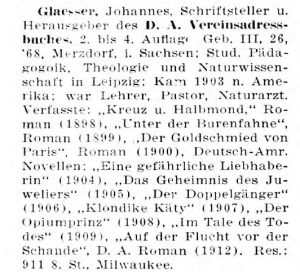
Johannes Glaesser was born March 26, 1868 in Merzdorf, Saxony. He studied pedagogy, theology, and natural science in Leipzig. In 1903, he emigrated to America, where he was a teacher, pastor, writer, and editor. He resided in Milwaukee, Wisconsin, from around 1912 until the early 1920s, was an active member of the Deutscher Press-Klub, Milwaukee (Deutsch Amerikanische Journalisten und Schriftsteller), and appears to have owned the German-American Directory Publishing Company, which produced an annual Deutsch-Amerikanisches Vereins-Adressbuch during these years. *
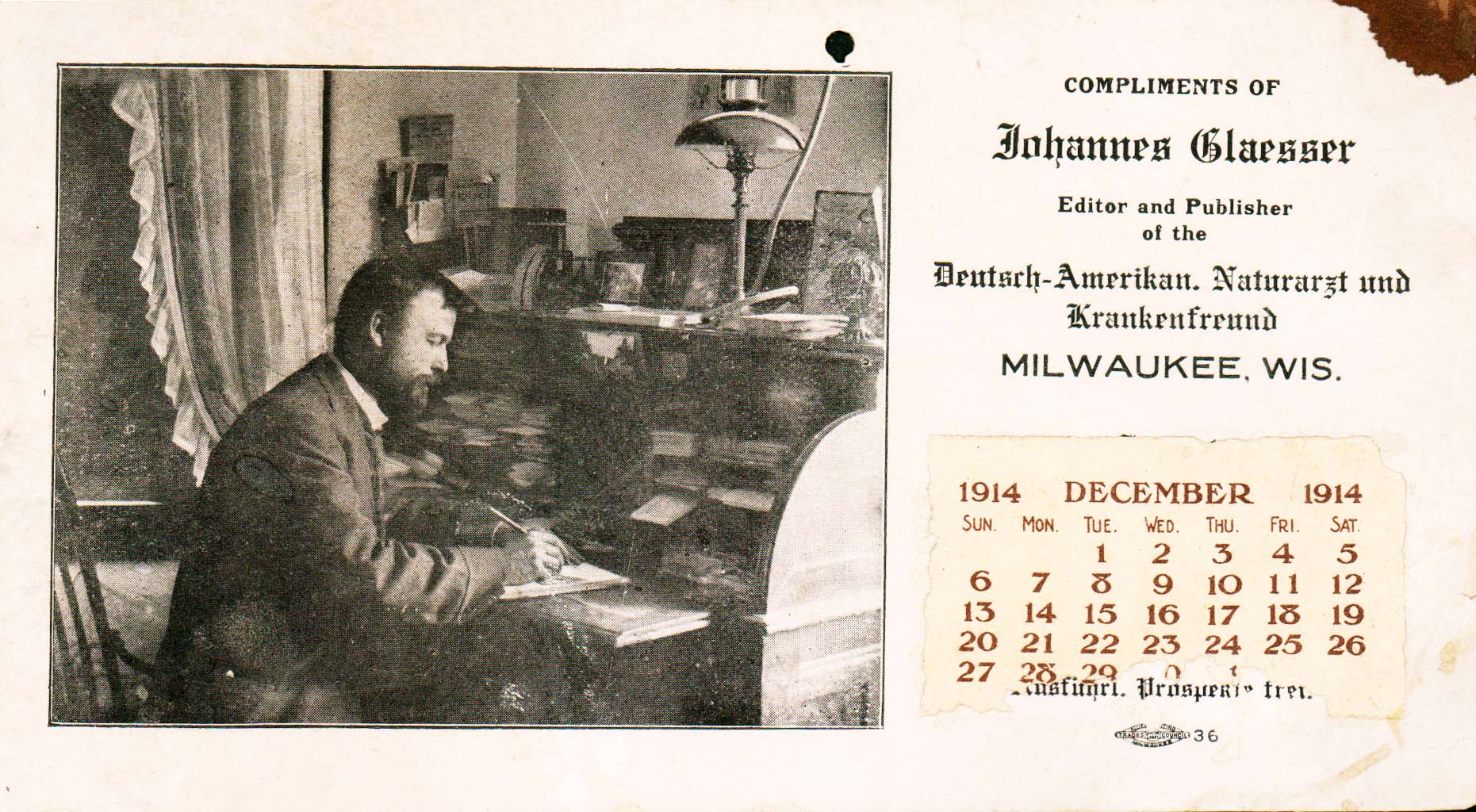
Attributed Works
Kreuz und Halbmond (1898)
Unter der Burenfahne (1899)
Der Goldschmied von Paris (1900)
Eine gefährliche Liebhaberin (1904)
Das Geheimnis des Juweliers (1905)
Der Doppelgänger (1906)
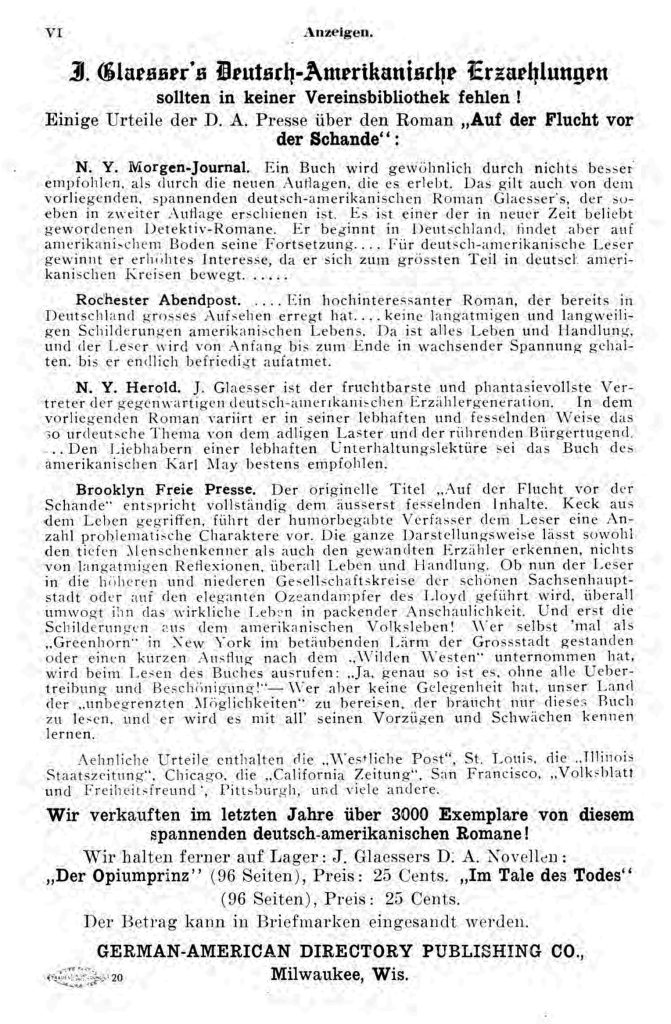
Der Opiumprinz. Amerikanische Detektivgeschichte aus der Chinssenstadt New-Yorks (1906)
Der Schatz der Irrsinnigen. Amerikanische Detektivgeschichte (1907)
Klondike Käty (1907)
Betrogene Betrüger. Amerikanische Detektivgeschichte (1908)
Das Geheimnis des Mormonen. Amerikanische Erzählung aus der Salzseestadt in Utah (1908)
Im Tale des Todes (1909)
Der Goldgräber. Amerikanische Erzaehlung aus den Goldfeldern von Klondyke (bei Otto Weber’s Verlag, Heilbronn, 1911?)
Auf der Flucht von der Schande (1912)
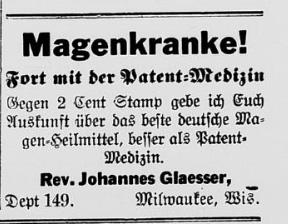
Deutsch-Amerikanischer Naturarzt und Krankenfreund (1914?)
John Ritsch Esquire (1915)
Der Gloria Onkel (humorous patriotic history in German America, 1916)]
Pastor J. Glaesser’s Kräuter-Buch. Die gebräuchlichen Heilkräuter, deren Bereitung, Anwendung und Wirkung in den verschiedenen Krankheiten, nebst einem Anhange: Uebersichtliche Zusammenstellung der wichtigsten Krankheiten und ihre Heilung durch Kräuter. (1920?)
It would appear Johannes Glaesser died March 4, 1927, at Emory University, DeKalb County, Georgia, and may be buried in Cincinnati, Ohio.
“* These Deutsch-Amerikanische Vereins-Adressbücher list German American organizations and clubs nationwide, providing “evidence of a vivid associational life in the German American community during the first decades of the twentieth century. For example, the 1916 club directory lists more than 4,000 social organizations across 45 different states with interests ranging from from the natural sciences to leagues for the German card game Skat, from occupation-based to ideological affinity groups, and from shooting societies to clubs dedicated to preparing annual carnival celebrations. The most popular type of group, however, were singing societies, which accounted for nearly one out of every four organizations. Less popular, but still significant were the Turnvereine, which combined physical exercise with enlightenment political ideas, and veteran’s clubs, each of which had established more than 300 different clubs.” [Resch, Tobias. 2022. Legacies of Participation: How Civil Society and Petitions Shape Legislative Institutions, Public Policy, and Representation. Doctoral dissertation, Harvard University Graduate School of Arts and Sciences.]